Showing posts with label statistics. Show all posts

Sunday, May 13, 2018

Visualizing Mortality


The Author is 34 and expecting to live to 90. If you are 17 expecting to live to 73, you have half as many X's and exactly the same number of winters. Your odds of living past 73 are pretty good but the shocking lack of infiniteness is unchanged.

Notably, the number of days you get to spend with your parents is probably already past the halfway mark. OTOH, the number of days you deliberately choose to spend with your parents may be much, much below halfway.

Tuesday, May 5, 2015

A Little Airline Attempt at Green Redemption

This is an interesting claim that it takes more energy to drive than to fly. No doubt the devil is in the details. And not all the details are clearly stated.

http://www.popularmechanics.com/cars/a9913/how-much-dirtier-is-driving-compared-to-flying-16365688/
For example, I doubt if the associated costs of air travel are included: driving to the airport, building an airport and parking lot, handling baggage, training airline staff. Should the energy of manufacture of cars and airplanes be included? I am making it awfully complex, but pretty clearly the details favor the car.

It is also based on the average types of trips taken. Cars log most of their miles on short trips with single occupants. This is a worst-case scenario for cars (ridiculously so for airplanes. No-one flies to the corner store. Hardly anyone flies an airplane solo.) The conclusion that airplanes are a more efficient means of doing a car's transportation doesn't follow.

Even so, the progress is evocative. It prompts some interesting questions. How long does a trip need to be to make a plane more efficient? What if the car had two occupants? ...three? ...five? ...seven? How long can the trend continue?

Friday, April 24, 2015

Go Play

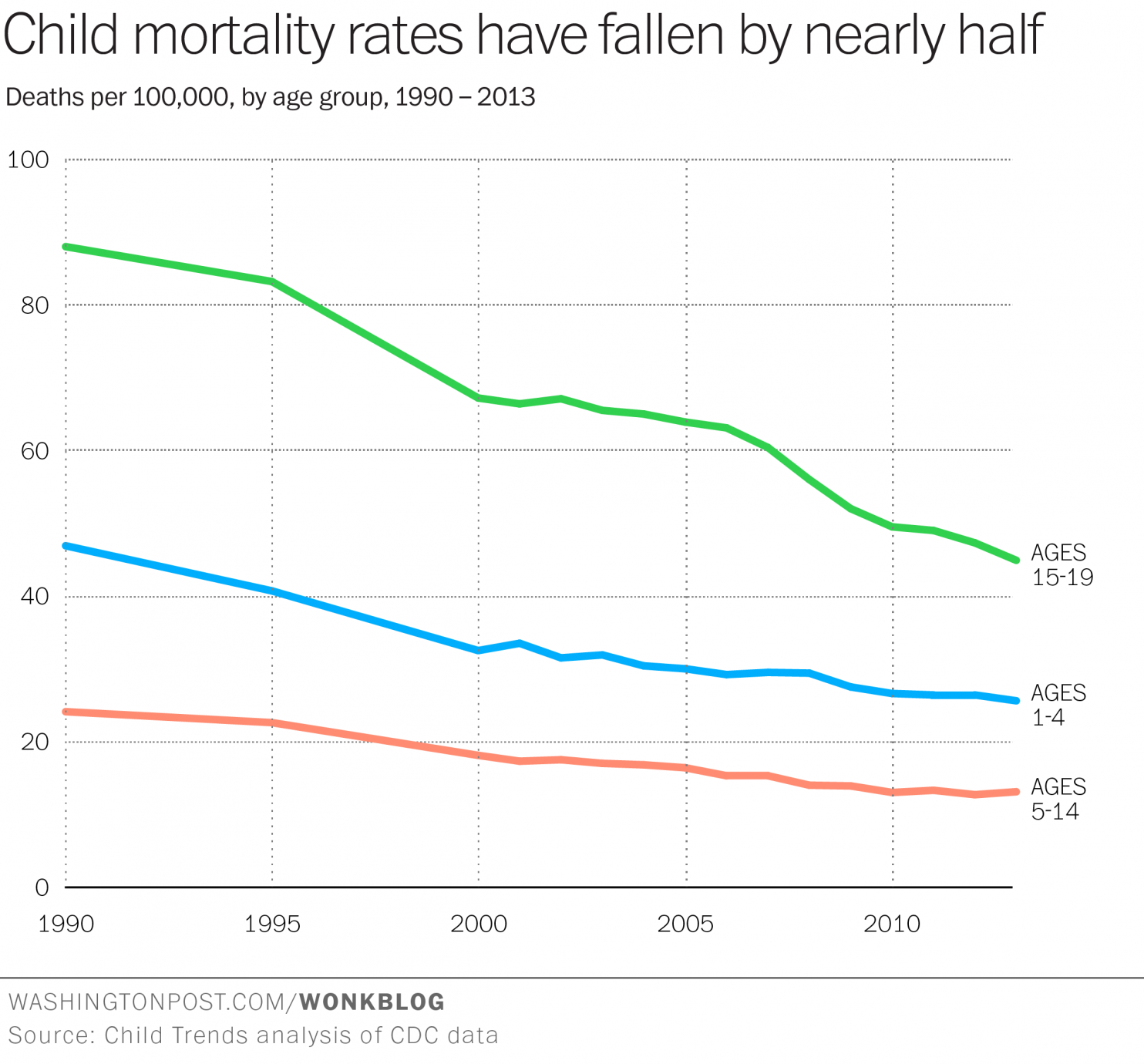
http://www.washingtonpost.com/blogs/wonkblog/wp/2015/04/14/theres-never-been-a-safer-time-to-be-a-kid-in-america/
They say parents these days are awfully protective, awfully afraid to take risks. Maybe we can relax a little.

Saturday, April 4, 2015

Why You Need to Understand Statistics

While this is "honest" in the sense of not being fraud, it is not honest in the sense of giving you the truth. If your skill in logic and statistics is weak, you will certainly walk away believing a falsehood. I'm not sure that is accidental.
More likely, it's a battle: an epic struggle between universities and student. You, to get their education and degree. They to get your money. Their side seems more sophisticated.
http://www.sodahead.com/united-states/us-v-joe-bruno-indictment-why-are-so-many-politicians-untrustworthy/question-240690/?link=ibaf&q=&imgurl=http://terrystuff.files.wordpress.com/2008/02/lawyers.gif
 Once upon a time, we marketed law schools with a printed brochure or two. That changed with the advent of the new century and the internet. Now marketing is pervasive: web pages, emails, blog posts, and forums.

With increased marketing, some educators began to worry about how we presented ourselves to students. As a sometime social scientist, I was particularly concerned about the way in which some law schools reported median salaries without disclosing the number of graduates supplying that information. A school could report that it had employment information from 99% of its graduates, that 60% were in private practice, and that the median salary for those private practitioners was $120,000. Nowhere did the reader learn that only 45% of the graduates reported salary information.

Saturday, January 3, 2015

Survivor Bias

http://youarenotsosmart.com/the-book/
Survivorship bias in a nutshell: If you look at a profession and think: "Wow, that is full of the most skillful, smart, dynamic and interesting people I've ever seen!", should you join that profession or avoid it? David McRaney says, "not so fast." The same thinking applies to aspiring actresses, WWII bombers and businesses.

Before you emulate the history of a famous company, Kahneman says, you should imagine going back in time when that company was just getting by and ask yourself if the outcome of its decisions were in any way predictable. If not, you are probably seeing patterns in hindsight where there was only chaos in the moment.

BTW, this is just one post. McRaney's blog (You Are Not So Smart) is full of long, interesting, thoughtful posts on how people think. He loves the counter-intuitive.

Sunday, July 20, 2014

High-School Crushes - Anylysed Mathematically!

John Paulos considers some statistics relevant to romantic crushes.
The second relevant statistical notion is Bayes’s theorem, a mathematical proposition that tells us how to update our estimates of people, events and situations in the light of new evidence.
http://www.allmusic.com/album/high-school-crush-mw0000811155 A mathematical example: Three coins are before you. They look identical, but one is weighted so it lands on heads just one-fourth of the time; the second is a normal coin, so heads come up half the time; and the third has heads on both sides.
Pick one of the coins at random. Since there are three coins, the probability that you chose the two-headed one is one-third. Now flip that coin three times. If it comes up heads all three times, you’ll very likely want to change your estimate of the probability that you chose the two-headed coin.
Bayes’s theorem tells you how to calculate the new odds; in this case it says the probability that you chose the two-headed coin is now 87.7 percent, up from the initial 33.3 percent.

Thursday, July 10, 2014

The Big Picture of the Summer Job

http://www.raisingarizonakids.com/2014/04/a-how-to-for-teens-seeking-summer-jobs/
 It looks like summer jobs are harder to get than they used to be. It's not just the recession. That was 7 years ago.
So what explains the trend? Are kids today lazy? Do they feel unprepared? Is minimum wage pressure pushing the lowest skill workers off the bottom? Are students competing with China or adults (who are competing with China?) This is US data. Is it competition from low-skill immigration?

(Dec'14) Megan McArdle talks a little about the effect of raising the minimum wage and a lot about how to read a social science study.
The Curmudgeon (p.42-4,91-5) says you should look for a lousy summer job (that pays well), or at least a real one. Avoid internships or cushy jobs with impressive titles.

Saturday, November 16, 2013

You're Over-Thinking It


http://b-womeninamericanhistory19.blogspot.ca/2012/06/before-i-phone.html
Scientific progress went much quicker in the 1800's. We figured out the electric motor, electricity,  steam train, engine, car, typewriter, mechanical calculator, telegraph, fiber optics, telephone, record player, movie, sewing machine, rubber, plastic, photograph, revolver, dynamite, antiseptic, pasteurization,


Nowadays, electronic devices become ever-smaller, medicine becomes ever more sophisticated but it seems our massive research efforts are just fine-tuning details. At best, we are just optimizing the great discoveries of yesteryear.

Around 1900, people discussed the idea that science must end. We had already discovered everything. My father ruminated on the thought through the 50's and asked me during the 80's whether there was anything left to discover about cars. Then a science prof of mine planted a slightly different explanation; we have already made all the easy discoveries. From here on, advances would only happen through careful analysis of subtle, hard-to-interpret results. Math, especially statistics, was about to get a whole lot harder.

Alternative explanation.