Showing posts with label physics. Show all posts

Tuesday, February 4, 2025

Of What Interest is Physics to a Psychologist?

 The Intersection of Science and Meaning

Jordan B Peterson, Oct 3, 2024 | Dr. Brian Greene | EP 486

Peterson talks to a physicist of string theory to ask him how physics might provide insight into ideas of psychology, philosophy and meaning. Here are some topics he gets into over the course of the hour and a half

1. The beginning of the universe – What does time mean at the beginning of time? (starting at 4:00)

2. (20:15) Green says something interesting about the second law of thermodynamics. Other physical laws, like the law of conservation of mass, are true. They can not be violated. The second law can be violated. It is just really unlikely.

Peterson asks a paradoxical question. The second law says the disordered states are more likely than ordered ones, but how do you define disordered? Isn’t one lottery ticket as unlikely as the next?


3. (37:42) How do you explain the double-slit experiment? If the stripe pattern happens because photons interfere with each other, how can you get the same pattern when you send one photon through at a time? This gets into some good questions about the limits of Einstein’s relativity. How does time work on a particle going so fast that time stops? What happens to a massless photon going so fast that mass becomes infinite? (Which leads into my favorite, how do we know that light goes the speed of light?)

4. (46:00)The quantum explanation, which says that you can’t ever know the location and speed of an object (The world you see is misleading about the fundamentals!), is not the only explanation that fits the data. De Broglie had a different interpretation that works.


5. (58:27) Greene talks about free will. He and Peterson lay out the usual positions. Particles behave in a deterministic way! Actions have predictable outcomes! Therefore everything is determined. So there is no free will. Peterson responds that at the quantum level there is no determinism, so Greene’s fixed chain of events is wrong. (Sounds like a first-year philosophy class. Then it takes a turn...)

Greene claims that the quantum world is not indeterminate. It is just too small to observe. All that probabilistic stuff of quantum mechanics is not real. It compensates for the fact that we can’t see the details of reactions. This seems to me relevant to a theological paradox. humans are free to act as we choose, to the point of following or not following God’s will. Yet God know the present, past and future, which depends on the choices that humans freely choose.

6. (1:07:00) Starts on string theory, which claims that it can combine general relativity (which works on big things) and quantum theory (which works on little things). String theory proponents say it is beautiful. Its detractors say it is not science. It has never made a testable prediction (I think they mean a novel testable prediction.) This looks to me like a very common choice between the scientific type (who makes a hypothesis, then waits for the results of the test) and the imaginative beauty-seeker.

Bonus idea: (50) tohu vabohu: Is it the state before the big bang (or, as its originator called it, the primeval atom)?

Wednesday, April 19, 2017

Something From Nothing

One of the weirder ideas of Quantum mechanics is that empty space is not empty at all. No matter how empty you make a space, pairs of particles and and anti-particles will spontaneously come into being move around for a while, then touch each other and disappear.

Apparently physics equations predict that this could happen. We just haven't had any evidence for it...and no idea how we could possibly get evidence. A few decades ago someone suggested that if it happened close enough to a black hole one half of that particle pair could be sucked into the black hole while the other half moved away and became permanent new matter in the universe.


This year, a team from the European Southern Observatory's Very Large Telescope found visual evidence via a phenomenon called vacuum birefringence.

Saturday, March 25, 2017

Cavendish


In 1797, Henry Cavendish performed one of the ten most clever science experiments in history by "weighing the earth".

Last month, John Walker recreated it in his basement.

Wednesday, March 9, 2016

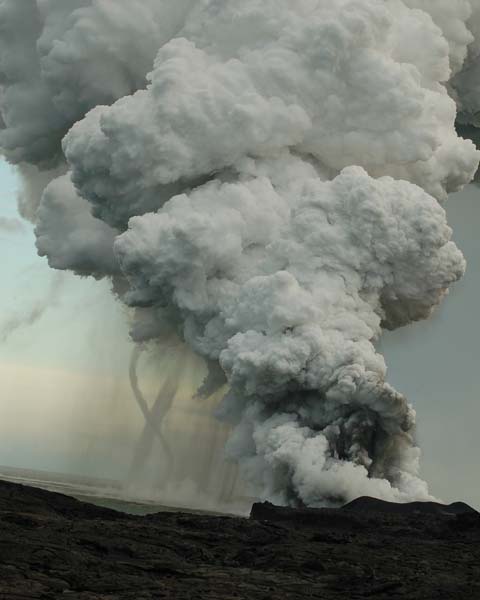
Do You See the Volcano Tornadoes?


http://www.aapt.org/Programs/contests/winnersfull.cfm?id=6571&theyear=2015

The American Association of Physics Teachers has posted the results of its 2015 photo contest. Sure the pictures are great; even better are some of the explanations that go with the winners.

Saturday, February 13, 2016

Gravity Waves

http://www.space.com/31922-gravitational-waves-detection-what-it-means.html

The news says gravity waves have been discovered. The headlines say "Einstein proven right" though really, the physics world was not all that apprehensive. The excitement is that we now have a new way to look at the world.


Space.com has a good news release with a video on the implications. Ricochet explains the experiment for an adult layman audience. This Verge video has the background, like how Einstein's concept of gravity is like bending space instead of Newton's idea of a force.

Thursday, October 15, 2015

New Frontiers in Fuel Efficiency

https://www.flickr.com/photos/libramano/9458548795/in/photostream/
This spring I posted a link to a super fuel efficient spacecraft that made its way to the asteroid Ceres. Instead of a rocket engine, NASA gave it an ion drive.
Well, now a university student in Australia has made an ion drive that is 50% more fuel efficient than NASA's previous record-holder.
The existing record is NASA's High Power Electric Propulsion (HiPeP) with 9,600 seconds, but fueled by magnesium Neumann's drive managed an estimated 14,600 seconds of specific impulse. He says "Other metals have lower efficiency, but higher thrust. So you would need more fuel to get to Mars, but could get there faster."

Wednesday, August 5, 2015

The Backyard Scientist

Mario Fireballs in high-res, slow motion video, home-made foundry, CO2 rocket launcher. Do I really need to add the “do not try this at home”, except, maybe the Lichtenberg figures. Maybe!

Drifting Tanks

If you thought drift cars were awesome, check out this from the Russian International Tank Biathlon. (Apparently, that last line translates to something like "You can't see that on YouTube." Russian speakers please advise in comments.)

Via the jaw-dropping military technology of Foxtrot Alpha.

Saturday, May 2, 2015

Driving Faster, Better

Skip barber's race school is famous and has been since the 80's.

What I Learned:
1. Making time on a track is about how fast you do the straights. How fast you do the straights is about how fast you exit the corner (and enter the next corner.)
2. Go through corners fast by picking the right line. The right line makes your rear tires travel in a constant-radius arc, touching at the turn-in, apex and track-out. Precise placement counts.
3. I usually turn in too early. If you are going to make an error, it is better turn in late. (Better because it gives you more margin, so more options.) This surprised me.
4. Brake late. Brake hard. Keep braking into the turn, easing off as you get into the turn.

Some of these things you can practice on the street or in a parking lot: precise position, choosing a line within your lane, late braking, getting on the throttle and doing it all smoothly, so the net acceleration is constant in magnitude, so that your passenger doesn't spill his drink. If you want to know how your car will behave at its limit, go to a race school or an autocross. I know of two on the island.

You can't learn car control on the street. It's not because your skill or natural talent is too low. It is because if you are driving at 98% (or 80%) and a dog runs onto the road, or you hit gravel, or a tourist stops erratically in front of you, the crash that will happen is out of your control. There is nothing you can do but wreck that car, or kill that dog, or worse. Courage is about accepting worthwhile risks that are within your control. Approaching vehicle limits on public streets fails on both counts.

Wednesday, March 25, 2015

Smarter Every Day at the Motocross Track

There are some really good YouTube video sites. My favorite science channel must be Smarter Every Day. In 3-8 minutes, Destin finds some interesting thing to describe and investigate. His giddy enthusiasm, unfailing wonder and wholesome, humble southern demeanor make it awesome*.
(Having a $100,000 camera that shoots 250,000 frames per second doesn't hurt, either.)
Here is Destin investigating angular momentum at the motocross track.
*Destin-approved vocabulary

Having watched every video, here is my annotated list of Smarter Every Day episodes.