Showing posts with label astronomy. Show all posts

Sunday, July 4, 2021

Technosignatures


When looking for life on other planets, we do not look for little green men, or cities, or canals. Telescopes are nowhere near powerful enough to see that kind of detail. Our best satellite-based telescopes hope to see a dot, if we are lucky, if we know where and when to look.

The way we look for life is to look at the color of that dot. The precise spectrum will indicate the chemicals that are present. Certain chemicals are a sign of life: molecular oxygen, for example. Oxygen bonds really well to very many chemicals. It is unlikely to see much of it unbonded. We only have unbonded oxygen on earth because we have plants that make it. Oxygen molecules are a sure sign of life. Methane is also a likely indicator. This makes oxygen molecules a biosignature: a sign of life.

Professor Adam Frank is looking for technosignatures: a light spectrum that indicate the presence of a technology-using society. Solar panels and pollutants are two types of technosignature.

Wednesday, April 19, 2017

Something From Nothing

One of the weirder ideas of Quantum mechanics is that empty space is not empty at all. No matter how empty you make a space, pairs of particles and and anti-particles will spontaneously come into being move around for a while, then touch each other and disappear.

Apparently physics equations predict that this could happen. We just haven't had any evidence for it...and no idea how we could possibly get evidence. A few decades ago someone suggested that if it happened close enough to a black hole one half of that particle pair could be sucked into the black hole while the other half moved away and became permanent new matter in the universe.


This year, a team from the European Southern Observatory's Very Large Telescope found visual evidence via a phenomenon called vacuum birefringence.

Saturday, February 13, 2016

Gravity Waves

http://www.space.com/31922-gravitational-waves-detection-what-it-means.html

The news says gravity waves have been discovered. The headlines say "Einstein proven right" though really, the physics world was not all that apprehensive. The excitement is that we now have a new way to look at the world.


Space.com has a good news release with a video on the implications. Ricochet explains the experiment for an adult layman audience. This Verge video has the background, like how Einstein's concept of gravity is like bending space instead of Newton's idea of a force.

Wednesday, March 25, 2015

Smarter Every Day at the Motocross Track

There are some really good YouTube video sites. My favorite science channel must be Smarter Every Day. In 3-8 minutes, Destin finds some interesting thing to describe and investigate. His giddy enthusiasm, unfailing wonder and wholesome, humble southern demeanor make it awesome*.
(Having a $100,000 camera that shoots 250,000 frames per second doesn't hurt, either.)
Here is Destin investigating angular momentum at the motocross track.
*Destin-approved vocabulary

Having watched every video, here is my annotated list of Smarter Every Day episodes.

Wednesday, September 17, 2014

Mining Opportunities in the New Frontier

http://www.nss.org/settlement/calendar/2009/BryanVersteeg-asteroid_mining.htmWhether in South America, California, the Yukon or Fort MacMurray, Mining has always been a challenging and rewarding opportunity for ambitious youth.


Last week, the US congress decided that any material recovered from an asteroid belongs to the people that recovered it. In other words, asteroid mining is legal. Now, by all appearances, asteroid mining is real. (Sept'14)

Update (Oct'14): How mining might work 

(Nov'15): The senate passes a bill.

Friday, September 12, 2014

How To Identify Life

...from a few light-years away.

http://scienceblogs.com/startswithabang/2012/06/12/sometimes-size-is-everything/
 If we are looking for life on an exoplanet, What do we look for? Well, radio signals and TV broadcasts would be sure signs, but awfully unlikely. Seeing trees or animals moving on the surface is proof but far beyond the ability of any telescope we can build or imagine building*.


Instead, we hope to analyze light from the planet. From this light we can identify the chemicals in the atmosphere using spectral analysis. Oxygen (O2) would be a good sign. It reacts so well that most atmospheres would use it all to make CO2 or H2O unless there was life to release it. Computer models now show that it is actually possible for an atmosphere to have oxygen and even ozone without ever having life. So even though oxygen is still a good sign. It is not proof. For solid proof, you would need to find oxygen, ozone, carbon dioxide, and methane with no carbon monoxide.

(Oct'15) How Space Telescopes Will Find Earth 2.0: progress in seeing an exoplanet. *

Friday, May 23, 2014

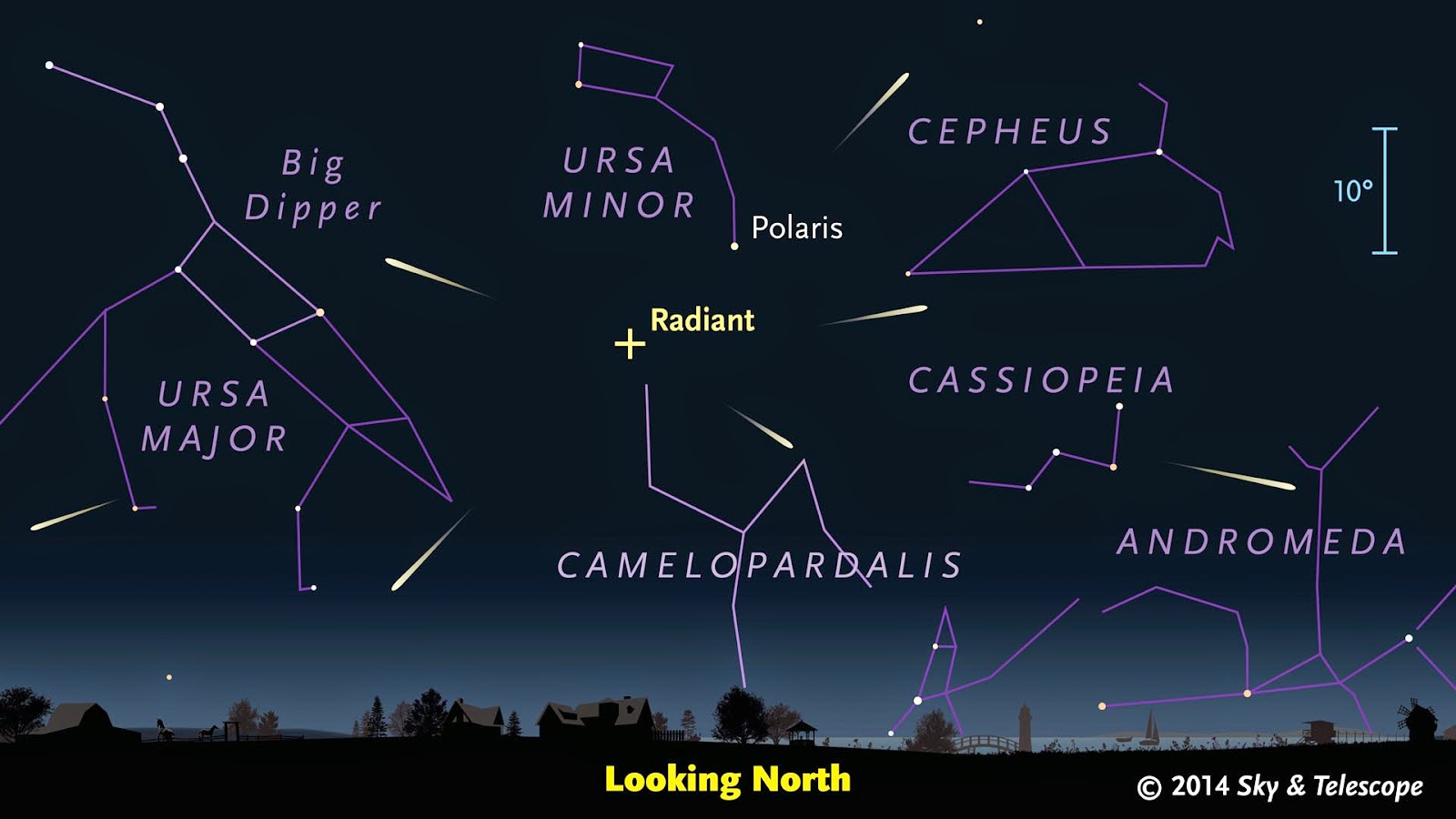
Meteor Shower Tonight

http://www.skyandtelescope.com/astronomy-news/observing-news/mays-surprise-meteor-shower/
That is, just after midnight, Friday, May 23 (aka early morning May 24) There will be a meteor shower called Camelopardalids. Look north. The meteors will appear to originate from just north of Polaris (the North Star).

Friday, October 21, 2011

Water!

Water has been found on another solar system in our galaxy. The star is 175 light years away, (That's relatively close.) But since it is about 1/1000th as old as our sun, I guess we won't be living there anytime soon.