
Monday, February 17, 2014
Math of Improbable Events


Thursday, February 13, 2014
Tuesday, January 28, 2014

Friday, January 24, 2014
That's Not an Explosion...
There is a supernova happening in the neighborhood. Actually, it happened about 12 million years ago but we get to see it now, for a couple of weeks. It seems like a busy neighborhood.

Sunday, January 12, 2014
Cheap Digital Microscope

Instructables.com has plans for a lens and stand that lets you use your smartphone as a digital microscope. They claim up to 175x magnification (with two lenses, up to 375x!) That is enough to look at onion cells. This is a maple seed pod at only 60x.
Project cost: $10
Saturday, January 11, 2014
Brown Dwarfs Detected

A brown dwarf is not like a white dwarf: on the death march of a real star. A brown dwarf is a star too small to kickstart full fusion, too small to emit light, but big enough to emit energy (as infrared) for billions of years and fantastic enough to have liquid iron falling from the sky as rain. A Canadian team is using the Spitzer IR Space Telescope to study them.
Thursday, January 9, 2014
Monday, January 6, 2014
Video Analysis

1. Tracker: My favorite so far. It is free, computer-based, open-source and looks transparent and powerful, for example:
- Fixed or time-varying coordinate system scale, origin and tilt.
- Multiple calibration options: tape, stick, calibration points and/or offset origin.
- Switch easily to center of mass and other reference frames.
- Protractors and tape measures provide easy distance and angle measurements.
- Define custom variables for plotting and analysis.
http://www.cabrillo.edu/~dbrown/tracker/help/frameset.html
2. Kinovea: a free, open-source sports analysis software with some good analysis tool including video magnification, slo-mo, data export to spreadsheets. The output looks beautiful
http://www.kinovea.org/
3. Vernier Physics: a $5 app for iPhone & iPad. Vernier is popular and looks convenient for people who already use iPhones. But it requires you to:
1. not move the camera and
2. mark each frame manually.
3. You can't export your info to a spreadsheet.
http://www.vernier.com/products/software/video-physics/
Update(Jan'15)-Destin from Smarter Every Day shows how to analyse a grasshopper using Tracker. If that was a little fast, watch his tutorial. (Destin has linked all you need in the "show more" box of the first video. When I tried repeating his work, the windows version of Tracker wouldn't work on every computer but the ".jar" file did. On some computers Destin's You-tube video (step #3) worked. On others, only Quicktime worked. Try stuff.
Sunday, January 5, 2014

Monday, December 30, 2013
Antarctic =/= Arctic
If you, like me, always assumed that the Antarctic was pretty much like the arctic but with penguins instead of polar bears, Dr. Kyla would like to set you straight.

Saturday, December 21, 2013
What Do the Boys Like?
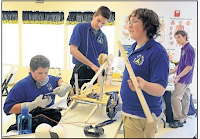
A 2009 study "asked teachers and students to 'narrate clearly and objectively an instructional activity that is especially, perhaps unusually, effective in heightening boys’ learning.' The responses–2,500 in all–revealed eight categories of instruction that succeeded in teaching boys.":
-
Lessons that result in an end product–a booklet, a catapult, a poem, or a comic strip, for example.
-
Lessons that are structured as competitive games.
-
Lessons requiring motor activity.
-
Lessons requiring boys to assume responsibility for the learning of others.
-
Lessons that require boys to address open questions or unsolved problems.
-
Lessons that require a combination of competition and teamwork.
-
Lessons that focus on independent, personal discovery and realization.
-
Lessons that introduce drama in the form of novelty or surprise.
Actually, lessons that include this kind of stuff tend to get praise from the girls too.
via
Saturday, November 16, 2013
You're Over-Thinking It

Nowadays, electronic devices become ever-smaller, medicine becomes ever more sophisticated but it seems our massive research efforts are just fine-tuning details. At best, we are just optimizing the great discoveries of yesteryear.
Around 1900, people discussed the idea that science must end. We had already discovered everything. My father ruminated on the thought through the 50's and asked me during the 80's whether there was anything left to discover about cars. Then a science prof of mine planted a slightly different explanation; we have already made all the easy discoveries. From here on, advances would only happen through careful analysis of subtle, hard-to-interpret results. Math, especially statistics, was about to get a whole lot harder.
Alternative explanation.
Friday, November 15, 2013
This is Saturn
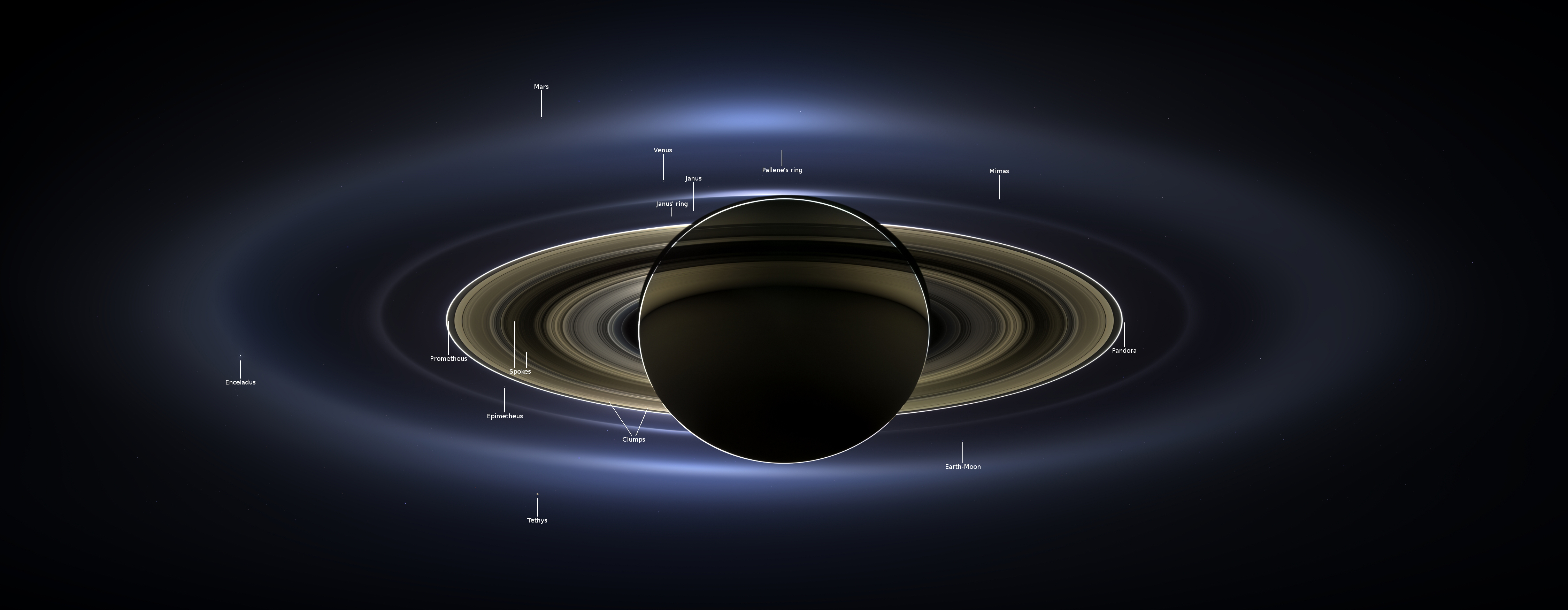
A real, true-color, photograph of Saturn, taken with the sun in the background!
(Click and zoom to read the labels.)

(Click and zoom to read the labels.)
Monday, October 21, 2013

Saturday, October 19, 2013
Global Warming Crisis

Larry Bell makes the case that global warming is causing a crisis: its effect on science.The latest IPCC report deals with the fact that the climate models (computer programs) that it has relied upon for predictions of the next 50-200 years have been proven spectacularly wrong. The IPCC response:
2001: “Most of the observed warming over the last 50 years is likely to have been due to the increase in greenhouse gas concentrations”.That's right, the first half-decade of test results show no evidence to support the hypothesis.
2007: “Most of the observed increase in global average temperatures since the mid-20th century is very likely due to the observed increase in anthropogenic greenhouse gas concentrations.”
2013 (leaked draft): “It is extremely likely that human influence on climate caused more than half of the observed increase in global average surface temperature from 1951 to 2010.”
conclusion: we are "very likely" right.
The second half decade of results are an undeniable refutation.
conclusion: we are "extremely likely" to be right.
This, my friends, is a dramatic new development in the scientific method. For those of us who liked the old scientific method, it is a crisis.
Tuesday, October 8, 2013
Advice for Young Women: Obvious and Rarely Stated

There are some head-smackingly bad ideas around, especially aimed at girls. Megan Fox is calling some out.
Tuesday, August 27, 2013
The Head, It Does Not Always Rule the Heart
That quote from Luba in 1983 may be true in ways she never imagined.

...Greenblatt’s provocative idea — that psychiatric woes can be solved by targeting the digestive system — is increasingly reinforced by cutting-edge science. For decades, researchers have known of the connection between the brain and the gut. Anxiety often causes nausea and diarrhea, and depression can change appetite. The connection may have been established, but scientists thought communication was one way: it traveled from the brain to the gut, and not the other way around.But now, a new understanding of the trillions of microbes living in our guts reveals that this communication process is more like a multi-lane superhighway than a one-way street....
... this radical treatment protocol has actually been decades in the making...
Greenblatt's actually targeting a vast, complex, and mysterious realm of the human body ...recent research suggests that early microbiome development might play a key role in at least some aspects of one’s adult mental health...
Wednesday, August 7, 2013
Exclusive for 90 Years

Intellectual property rights are intended to encourage creators (inventor and authors) to create. The idea is that we give the creators exclusive rights to make money from their creations and they will spend more effort in creating them. It seems to work pretty well in the patent world. An inventor has 20 years to earn an income from his invention.
Authors get 90 years. Few authors even live 90 years beyond their publication date. How can this be a good idea? Sure, it may be good for the author but how is it good for society? (...and if it isn't good for society, why would society enforce it?) The lawyers' claim is that the ability to make money will ensure that the books stay in print and are accessible.
 This does not match my idea of common sense. When works are out of copyright, they will be cheaper. Also, other writers can use parts of the work or make new creations around it: write a screenplay, use poetry as lyrics or incorporate segments of video. A new generation of creators can create without the cost or legal confusion of navigating copyright. Evidence says that my intuition is right and the lawyers are wrong.
Thursday, July 25, 2013
20 Habits Associated with Success

Tom Corley has identified 20 things that rich people do overwhelmingly and poor people do rarely. Correlation is not causation but it's not hard to imagine how the the "rich" habits might have something to do with success.
(July'19) broken original links replaced
Thursday, July 11, 2013
Salt! What's Next?

I'm always skeptical of diet advice but some facts are clearly established. For example: most Americans should eat less and exercise more; eat less fat; eat less processed foods; eat more fruits and vegetables, especially raw; eat less salt. Surely the basics are true?
Next, they'll be telling me not to wear sunblock!
Subscribe to:
Posts (Atom)